Our world and our students' worlds are so different.
I needed to teach a lesson on puns to my Form IIIs. My sister occasionally sends comic strips she cuts out from the newspaper. I had saved several of them thinking I could use them as a teaching aid.
I started the lesson with the definition of a pun and gave a few examples:
* A backward poet writes inverse.
* She had a boyfriend with a wooden leg, but broke it off.
* With her marriage she got a new name and a dress.
* A pessimist's blood type is b-negative.
As English is the girls' third or even fourth language, we spend a lot of time clarifying meanings of words. The dictionary is our best friend.
Then I decided to use one of those comic strips from my sister. It showed a teenager walking around holding an avocado for about six frames. In the last frame he goes into the dining room where his parents are seated. He asks, "How much longer do I have to hold the guacamole?" His dad says to his wife, "Never send Norman to make a taco."
Do you know how long it took to explain American culture so they could appreciate the humour? I needed to tell them what a taco is, what guacamole is, how to make it, how to eat it, even what "hold the _____" means. About five minutes into the explanation I wondered why I had ever started. However, the girls loved the lesson. As I was leaving class that day one of them said, "That was a fun lesson."
During my research on puns I discovered a website that has a pun a day. I think we'll start lessons for the next week or so with a pun. What a great way to encourage vocabulary and critical thinking.
A funny side note - the girls made me reexplain how to make guacamole so they could write down the recipe. Some of them even jotted down what is in a taco. I wonder how many of them are going to try them over December holiday?
Friday, October 28, 2011

Sunday, October 23, 2011
Lorugum Confirmation
John O'Donoghue and I had the opportunity to travel with a media team from Maryknoll to Lodwar. The media team was made up of three people all photographers and two of them produce a radio show, Voices of the World, for the Maryknoll Society (Fathers). They came to Kenya to focus on the ministries of the MK Fathers, Sisters, Lay Missioners as well as the famine in Kenya. We traveled to the Lodwar dioceses because that is one of the areas that is experiencing extreme drought in Kenya.
Lodwar is located in the north western part of Kenya in an arid area receiving less than ten inches of rain a year and is considered to be a hardship area. Unless you are located next to a river which holds water year round, nothing grows there. All food and supplies must be brought in. Very few people live in this area. The tribe that does is known as the Turkana. They are pastoralists raising cattle, goats and a few camels roaming wherever they can find food and water for their animals. They are a marginalized people being so far removed from major cities adn government services. Many of their children still do not have the opportunity to go to school. Women are able to earn some income from their beautiful woven baskets and mats.
You can see one of the dry riverbeds we crossed to get to Lorugum. When it rains they have terrible flash flooding as the soil can't hold any water. It is all sand.
 This is a typical Turkana home built out of brush. As they are nomadic people it doesn't need to last long.
It was an insightful and interesting trip. On Sunday we had the opportunity to travel with Bishop Dominic Kimengich to celebrate confirmation at Lorugum, one of the outstations of the diocese. Bishop Kimengich has been bishop there for less than one year so this was the first time he had visited the parish. They were thrilled and he was warmly received. Bishop Kimengich is young, energetic and seems to be deeply aware of the needs of his people. You should have heard the excitement when he danced with the women at the end of the Mass. They danced all around the church celebrating together.
The Turkana still hold on to many of their traditional ways of life because they are so far removed from the rest of the country. Missionaries didn't even come into this area until the early 1960s! I loved the bright coloured clothing and jewelry.
After Mass we enjoyed lunch with the two different groups of nuns who work in Lorugum. They run a clinic and secondary school. Later that afternoon we visited Turkana Girls' Secondary School. While we were there we met with the Form IV (seniors) girls. They were beginning their KCSE exams on Tuesday. We had a short assembly where all addressed them for a few minutes wishing them luck. The highlight was the Bishop blessing each and every girl regardless of religious beliefs. As he said, "You are all children of God and we want what is the very best for you."
As we returned to Lodwar we were greeted by these men on their way to some sort of celebration.
Click here for additional photos of this day.
Lodwar is located in the north western part of Kenya in an arid area receiving less than ten inches of rain a year and is considered to be a hardship area. Unless you are located next to a river which holds water year round, nothing grows there. All food and supplies must be brought in. Very few people live in this area. The tribe that does is known as the Turkana. They are pastoralists raising cattle, goats and a few camels roaming wherever they can find food and water for their animals. They are a marginalized people being so far removed from major cities adn government services. Many of their children still do not have the opportunity to go to school. Women are able to earn some income from their beautiful woven baskets and mats.

You can see one of the dry riverbeds we crossed to get to Lorugum. When it rains they have terrible flash flooding as the soil can't hold any water. It is all sand.

It was an insightful and interesting trip. On Sunday we had the opportunity to travel with Bishop Dominic Kimengich to celebrate confirmation at Lorugum, one of the outstations of the diocese. Bishop Kimengich has been bishop there for less than one year so this was the first time he had visited the parish. They were thrilled and he was warmly received. Bishop Kimengich is young, energetic and seems to be deeply aware of the needs of his people. You should have heard the excitement when he danced with the women at the end of the Mass. They danced all around the church celebrating together.

The Turkana still hold on to many of their traditional ways of life because they are so far removed from the rest of the country. Missionaries didn't even come into this area until the early 1960s! I loved the bright coloured clothing and jewelry.
After Mass we enjoyed lunch with the two different groups of nuns who work in Lorugum. They run a clinic and secondary school. Later that afternoon we visited Turkana Girls' Secondary School. While we were there we met with the Form IV

As we returned to Lodwar we were greeted by these men on their way to some sort of celebration.

Click here for additional photos of this day.
Friday, October 14, 2011
Father Joe's Visit
As I’ve written before the Maryknoll Fathers and Brothers are celebrating their centennial this year. As part of their celebrations, Father Joe Healy came to Kitale this weekend with two cameramen as they are making a documentary about the work Maryknoll is doing in Kenya. He spent Friday visiting our ministry sites.

Kathy was thrilled with the way things turned out for her. She is now working at St. Raphael Clinic in Matisi, a slum of Kitale. On Monday they opened a maternity ward at the hospital with a Mass by Bishop Crowley. Can you believe that on Friday morning their first baby was born. During his visit Fr. Joe was able to bless this special baby whose name is Raphael.

Nothing quite so exciting happened while he was visiting our schools. While at St. Anthony’s he was able to address the entire student body while they were still on morning parade. Fr. Joe is a real sports enthusiast so the boys were excited to have someone discuss sports. He visited John’s maths classroom and decided that he didn’t want any part of teaching high school maths but was able to tell a couple of stories.
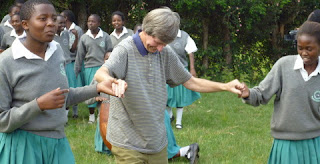
At St. Monica’s he visited my Form I English class for a few minutes. We then went down to the playing field and sang several songs for him. Of course in Kenya, you don’t just sing you must dance. At one point even John O’Donoghue and Fr. Joe got into the act.
Sunday Maryknoll was honored during the 7:00 am Mass said by Bishop Crowley. That evening we all had a wonderful meal at Karabuni Lodge with the Bishop. It truly is an honor to be a part of the Maryknoll family.
To see more photos click here.

Kathy was thrilled with the way things turned out for her. She is now working at St. Raphael Clinic in Matisi, a slum of Kitale. On Monday they opened a maternity ward at the hospital with a Mass by Bishop Crowley. Can you believe that on Friday morning their first baby was born. During his visit Fr. Joe was able to bless this special baby whose name is Raphael.

Nothing quite so exciting happened while he was visiting our schools. While at St. Anthony’s he was able to address the entire student body while they were still on morning parade. Fr. Joe is a real sports enthusiast so the boys were excited to have someone discuss sports. He visited John’s maths classroom and decided that he didn’t want any part of teaching high school maths but was able to tell a couple of stories.

At St. Monica’s he visited my Form I English class for a few minutes. We then went down to the playing field and sang several songs for him. Of course in Kenya, you don’t just sing you must dance. At one point even John O’Donoghue and Fr. Joe got into the act.

Sunday Maryknoll was honored during the 7:00 am Mass said by Bishop Crowley. That evening we all had a wonderful meal at Karabuni Lodge with the Bishop. It truly is an honor to be a part of the Maryknoll family.
To see more photos click here.
Thursday, September 15, 2011
Escort
I never cease to be amazed at how the English language can be so different in another place.
Class had just been dismissed for tea. I hung around outside the classroom door because I needed to collect papers from a few of the girls. Instead of running to the dining hall to get their tea, about four girls sat down on the grass to bask in the sun. This is our conversation.
“Aren’t you girls going to go get your tea?” I asked.
“No,” they replied, “we don’t have an escort.”
Laughingly I said, “I’ll take you down to the dining hall and be your escort.” There was no reply. So I continued, “Did you get in trouble or something? Is there some reason you can’t go to the dining hall?”
Then they started laughing, “Since we don’t have anything to take with our tea we don’t want it.”
“Oh, you want something to eat with your tea, bread or something. Is that right?”
That is one time the Oxford Dictionary didn’t help me!
Here’s another example that I’ve run across several times this week as I’ve graded compositions, but this one is in the Oxford Dictionary. I had no otherwise but to go home. Definition of otherwise: choice.
Class had just been dismissed for tea. I hung around outside the classroom door because I needed to collect papers from a few of the girls. Instead of running to the dining hall to get their tea, about four girls sat down on the grass to bask in the sun. This is our conversation.
“Aren’t you girls going to go get your tea?” I asked.
“No,” they replied, “we don’t have an escort.”
Laughingly I said, “I’ll take you down to the dining hall and be your escort.” There was no reply. So I continued, “Did you get in trouble or something? Is there some reason you can’t go to the dining hall?”
Then they started laughing, “Since we don’t have anything to take with our tea we don’t want it.”
“Oh, you want something to eat with your tea, bread or something. Is that right?”
That is one time the Oxford Dictionary didn’t help me!
Here’s another example that I’ve run across several times this week as I’ve graded compositions, but this one is in the Oxford Dictionary. I had no otherwise but to go home. Definition of otherwise: choice.
Wednesday, September 14, 2011
Visit to Ortum
We’ve had a guest in Kitale. Maria, a registered nurse, is thinking about becoming a Maryknoll Lay Missioner. She is here for three weeks to see the reality of health care in Kenya and opportunities for future mission. Kathy has done a great job scheduling visits for her. Last week they traveled to Ortum to visit the  Mission Hospital and Nursing School there. Since I didn’t need to go to school that day, I asked if I could tag along. It was a beautiful trip and informative visit.
In 1956 the Kiltegan priests and Daughters of the Holy Rosary, both Irish mission organizations, started work in Ortum. Ortum is in West Pokot located about two hours north of Kitale in the Cherangani Hills. There they established a mission church, schools and a hospital. Later they added a nursing school, one of the best in Kenya.
The hospital and nursing school were impressive. The Sisters still run both institutions. The nursing school has about 100 students. Because they are so well trained, when they complete nurses’ training they are snatched up in the job market. The hospital is well equipped and offers many services not found elsewhere. One of those is a place where expectant mothers can come and live for free while they are awaiting the birth of their baby. Since this area is sparsely
populated and people must travel far through mountains by foot, if women wait until they are in labour to come to the hospital, they won’t make it on time to deliver!
The people native to this area are the Pokots. Because they live in a remote area many of them still follow traditional ways of life. It is a goal of Bishop Crowley, to help educate these people to improve the quality of their life. I do have several girls from West Pokot in my classes.
The Pokots are divided into two main groups. The Hill Pokot live in the Cherangani Hills (where we were) and practice both pastoralism and farming growing maize. The other group are the Plains Pokot who live in arid plains where they herd cows, goats and sheep. Whether a pastoralist or a farmer, wealth among the Pokot is measured by the number of cattle one has. Cattle are used to barter and to pay bride price (dowry). As long as a man has enough cows to offer, marrying more than one wife is allowed.
Dairy products such as milk, butter and cheese are the staple diet of the Pokot. They make porridge from wild fruits boiled with a mixture of milk and blood from cattle. Cattle are seldom slaughtered for meat because they are more valuable alive. Pokot women traditionally wear colorful necklaces and beaded headgear, brass jewelry and big loop type earrings whereas men wear just a few wrap garments and cowhide capes and shirts. Pokot warriors wear red clay on their hair with feathers.
To see more pictures of the area around Ortum, click here.

In 1956 the Kiltegan priests and Daughters of the Holy Rosary, both Irish mission organizations, started work in Ortum. Ortum is in West Pokot located about two hours north of Kitale in the Cherangani Hills. There they established a mission church, schools and a hospital. Later they added a nursing school, one of the best in Kenya.
The hospital and nursing school were impressive. The Sisters still run both

populated and people must travel far through mountains by foot, if women wait until they are in labour to come to the hospital, they won’t make it on time to deliver!
The people native to this area are the Pokots. Because they live in a remote area many of them still follow traditional ways of life. It is a goal of Bishop Crowley, to help educate these people to improve the quality of their life. I do have several girls from West Pokot in my classes.
The Pokots are divided into two main groups. The Hill Pokot live in the Cherangani Hills (where we were) and practice both pastoralism and farming growing maize. The other group are the Plains Pokot who live in arid plains where they herd cows, goats and sheep. Whether a pastoralist or a farmer, wealth among the Pokot is measured by the number of cattle one has. Cattle are used to barter and to pay bride price (dowry). As long as a man has enough cows to offer, marrying more than one wife is allowed.
Dairy products such as milk, butter and cheese are the staple diet of the Pokot.

To see more pictures of the area around Ortum, click here.
Saturday, September 10, 2011
Ft. Jesus and Old Town Mombasa
While in Mombasa, we spent a day enjoying some historic sites there: Fort Jesus and Old Town. The word Mombasa means “Island of War” which aptly fits as there  have been many battles and intrigues involving its ownership. It is one of East Africa’s oldest settlements. Some claim settlements have existed there for at least 2000 years.
Due to the importance of the natural harbour ships from Arabia, Persia,Yemen, Iran, India and even China created major trading center in Mombasa. Traders from countries to the East were interested in spices, gold, ivory, millet, seamum, coconuts, and slaves. The Kiswahili language is said to have originated here as a language of trade with words derived from Arabic, Indian, Portuguese and English.
Much later the Europeans realized its economic value. Vasco da Gama stopped there in 1498, however, he wasn’t allowed to enter the port. Almost a hundred years later, Portugal obtained dominion and built Ft. Jesus to protect its interests. The fort was the main hub for trading, a prison for slaves, and protection for their own soldiers. The popular trade goods at that time were spices, cotton, coffee and slaves.
The Portuguese were overthrown by Omani Arabs in 1698 after being under siege for two years and nine months. And then in 1887 the British took control of the city. Between 1631 and 1875 the fort was won and lost nine times.
The Portuguese sailed under the flag of the Order of Christ, not the Portuguese flag, since they regarded themselves as representatives of Christendom. So it was natural that they named it Fort Jesus. Ft. Jesus was built in the shape of a man as viewed from above. It was the first European-style fort constructed outside of Europe designed to resist cannon fire. A quote from the brochure pretty well sums up the fort’s history, “Fort Jesus has suffered a history of murder, siege, starvation, bombardment and treachery that makes our modern world of hi-jacking and thuggery seem quite tame.”
Old Town is located just outside Ft. Jesus. It is filled with buildings influenced by Islamic and Portuguese architecture. The carved wooden doors and balconies are beautiful.
For additional photos click here.

Due to the importance of the natural harbour ships from Arabia, Persia,Yemen, Iran, India and even China created major trading center in Mombasa. Traders from countries to the East were interested in spices, gold, ivory, millet, seamum, coconuts, and slaves. The Kiswahili language is said to have originated here as a language of trade with words derived from Arabic, Indian, Portuguese and English.
Much later the Europeans realized its economic value. Vasco da Gama stopped there in 1498, however, he wasn’t allowed to enter the port. Almost a hundred years

The Portuguese were overthrown by Omani Arabs in 1698 after being under siege for two years and nine months. And then in 1887 the British took control of the city. Between 1631 and 1875 the fort was won and lost nine times.
The Portuguese sailed under the flag of the Order of Christ, not the Portuguese flag, since they regarded themselves as representatives of Christendom. So it was natural that they named it Fort Jesus. Ft. Jesus was built in the shape of a man

Old Town is located just outside Ft. Jesus. It is filled with buildings influenced by Islamic and Portuguese architecture. The carved wooden doors and balconies are beautiful.
For additional photos click here.
Thursday, September 8, 2011
Fire at St. Anthony's
As I was walking to school this morning the only fire truck in town was going towards St. Anthony’s. When I got to school I knew something was wrong as there were many motorcycles and no kids in class.
As I passed the academic block I could see the fire truck near one of the dormitories plus students and some adults standing around. One of the dorms had caught fire between 5:00 and 5:30. The fire department was putting out what was left of the fire. Luckily the boys were at morning preps in their classrooms. Thank God no one was injured. About 120 boys lost all their belongings.
While an emergency Board of Governors meeting was being held I went to all the form 1 and 2 classrooms and told them how sorry I was about the fire but my prayers were answered that no one was hurt. We can replace clothes, books, etc. but not human life. Other teachers were busy consoling and helping boys who had lost things. Parents and people from town started coming to see the damage.
We had a school assembly after the BOG meeting. We had speeches of encouragement from the principal, acting head of school board, head of PTA, plus some other officials who were around. After parade we had tea break. After I "took" my tea, I headed back to the dorm area. Some parents and more town people were coming to see the damage. Some of the boys were able to go in and try to get their locker (trunk) out of the dorm. Finally I decided I might as well go into my math classes and do some review at least that might keep them busy.
 After lunch I went back to the dorm area. The dorm had finally cooled down enough that all the boys could get their trunks out. Most the boys only found ashes in their trunk or things were so badly burned that they were not salvageable. One boy was really upset so I let him use my phone to call his parents. You could see the relief on his face as he was able to visit with his mother. I even received a call from a parent who was concerned about her son so I had Moses call his mother. The media here is not real reliable and likes to sensationalize. She had heard that some boys were killed in the fire.
After lunch I had learned the following. The boys whose dorm caught fire would double up or use bunks of boys who have not returned to school yet because of the teacher's strike. One of the counselors told me that a few of the boys were depressed because they knew their parents had used all they had to put the them in school and did not have any money to replace what they had lost. PTA will set up a fund to buy some of the things the boys lost. And finally, we will start exams tomorrow morning.
One thing that really struck me was a comment I heard. "Yes, it was a bad loss for the boys, but they need to learn to move on with life." Another one told me that there is much tragedy and one might as well learn at an early age to keep moving forward with their life. Not quite what I would hear in the States in the same circumstances.
I really feel for the counselors, the teacher who is head of boarding, the principal and teachers who stepped up to help. They really had a load on their shoulders today. My heart also goes out to the boys who lost things in the fire and all the boys. I am sure many will not sleep well tonight. But God did bless us in that no one was injured.
As I passed the academic block I could see the fire truck near one of the

While an emergency Board of Governors meeting was being held I went to all the form 1 and 2 classrooms and told them how sorry I was about the fire but my prayers

We had a school assembly after the BOG meeting. We had speeches of encouragement from the principal, acting head of school board, head of PTA, plus some other officials who were around. After parade we had tea break. After I "took" my tea, I headed back to the dorm area. Some parents and more town people were coming to see the damage. Some of the boys were able to go in and try to get their locker (trunk) out of the dorm. Finally I decided I might as well go into my math classes and do some review at least that might keep them busy.

After lunch I had learned the following. The boys whose dorm caught fire would double up or use bunks of boys who have not returned to school yet because of the

One thing that really struck me was a comment I heard. "Yes, it was a bad loss for the boys, but they need to learn to move on with life." Another one told me that there is much tragedy and one might as well learn at an early age to keep moving forward with their life. Not quite what I would hear in the States in the same circumstances.
I really feel for the counselors, the teacher who is head of boarding, the principal and teachers who stepped up to help. They really had a load on their shoulders today. My heart also goes out to the boys who lost things in the fire and all the boys. I am sure many will not sleep well tonight. But God did bless us in that no one was injured.
Subscribe to:
Posts (Atom)
